
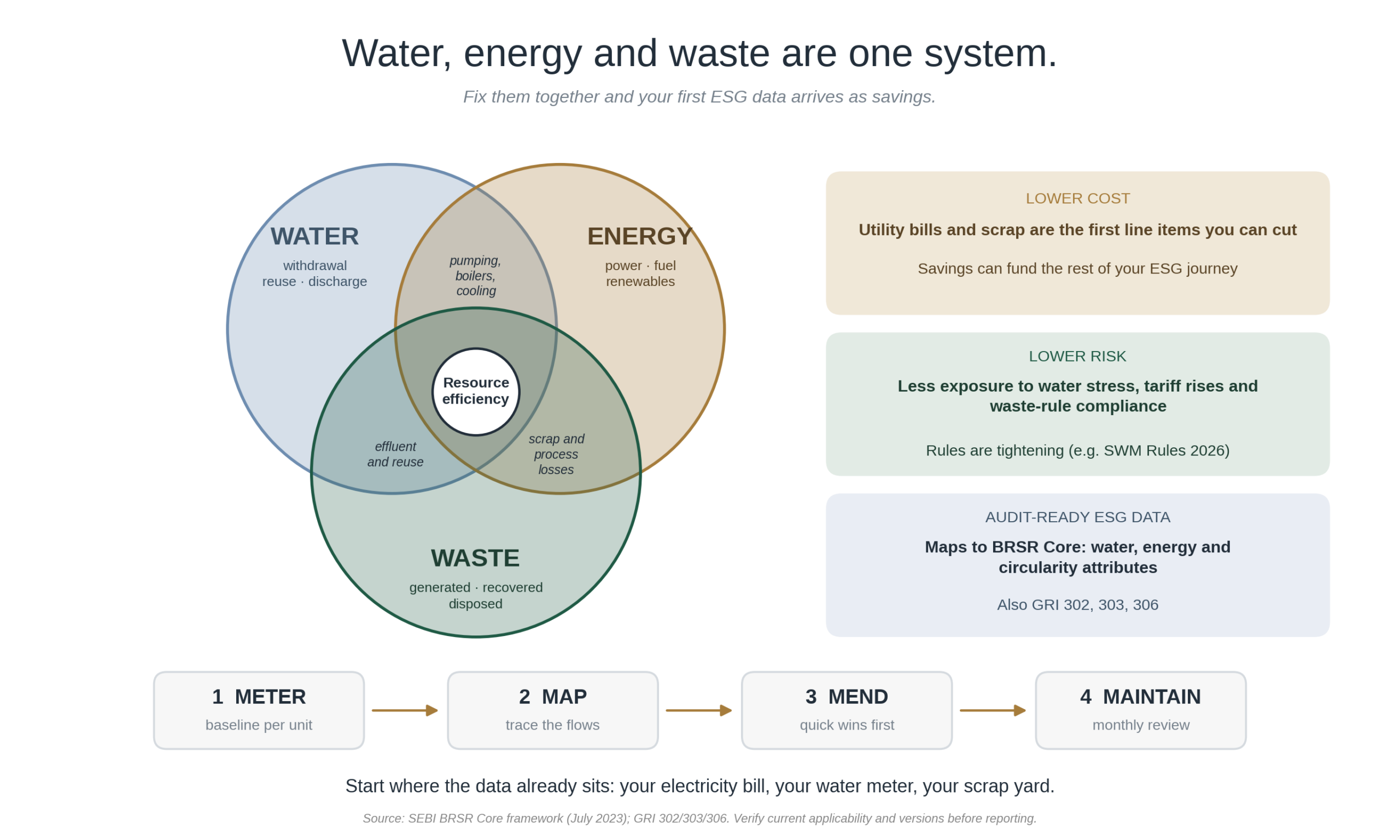
Before the frameworks, the disclosures and the assurance, the most practical ESG progress an SME can make sits in its utility bills and its scrap yard.
“Where do we start with ESG?” is the question I hear most from SME promoters. Policies, committees and frameworks all look like large projects. My usual answer is less glamorous: start with what you already pay for. Electricity, water and waste.
Three Meters, One System
Treat them as separate projects and you miss the savings that sit between them. Water needs energy to be pumped, heated and treated. Many processes use water for cooling and steam, so energy decisions change water demand. Waste is rarely just waste: it is water, energy and material you have already paid for, leaving the gate as cost.
The cross-benefits are practical. Recovering hot condensate returns heat and reduces make-up water. Reusing treated effluent for cooling or landscaping reduces freshwater withdrawal and discharge. Cutting scrap at source reduces the energy and water embedded in rework. The size of each gain is site-specific, so measure before you promise anything.
Why This Is the Right Place to Start
- You already have the data. Bills, meter readings and weighbridge slips exist in almost every SME. What is usually missing is compilation, not data.
- It pays before it reports. Housekeeping measures such as fixing leaks, curbing idle running and segregating waste at source typically need little capital. Savings vary widely by site.
- It maps to what buyers and regulators ask. Under SEBI’s BRSR Core, water footprint, energy footprint and circularity (waste) are among the nine attributes for assured disclosure by the top listed companies, as phased by SEBI. If you supply such companies, expect data requests down the value chain. Global frameworks mirror this: GRI 302 (Energy), 303 (Water and Effluents) and 306 (Waste), and ESRS E3 and E5 in the EU, though ESRS scope is under revision.
- Waste regulation is tightening. MoEFCC notified the Solid Waste Management Rules, 2026 in January 2026, effective 1 April 2026, replacing the 2016 rules. Secondary commentary reports new duties for bulk waste generators, including four-stream segregation and an extended-responsibility certificate mechanism.
The Resource Efficiency Loop: Meter, Map, Mend, Maintain
- Meter: build a baseline from twelve months of electricity, fuel, water and waste by stream. Express each per unit of output (kWh, kL or kg per tonne or per piece). Intensity shows whether you are improving while growing; absolute totals do not.
- Map: trace where each resource enters, what it does and where it leaves. Look for overlaps: heat leaving as hot water, treated water going to drain, usable scrap.
- Mend: take quick wins first (leaks, idle equipment, lighting and motor controls, source segregation, reuse points) before capital projects such as solar or effluent plant upgrades.
- Maintain: name an owner, hold a monthly review and keep a one-page dashboard. Keep the evidence trail (invoices, meter logs, weighbridge records) so the numbers can be assured later.
Which Numbers to Track
Keep the dashboard short. A workable starter set for a manufacturing SME is electricity per unit of output, fuel per unit of output, freshwater withdrawn per unit of output, total waste generated per unit of output, and the share of that waste recovered or recycled rather than disposed of. Add the share of electricity from renewable sources if you buy or generate any. These sit comfortably alongside the water, energy and waste indicators that BRSR Core and GRI ask for, so the effort is not wasted when a buyer later requests data.
Where Digital Fits
This is digitainability at its simplest. Sub-meters and basic data logging turn a monthly bill into near-real-time visibility, and a simple dashboard will show a night-time spike that nobody noticed. Start modestly. A spreadsheet with disciplined monthly entry beats a sophisticated platform that nobody maintains. Sensor and software costs vary, so obtain current quotes.
An Illustrative Scenario
A mid-sized processing unit compiles twelve months of bills and logs. Per-tonne intensity shows water use rising faster than output. A one-day walk-through finds a cooling circuit overflowing continuously and a hot condensate stream going to drain. Fixing both costs little, cuts water and fuel together, and gives the unit its first baseline numbers before any ESG policy has been written. The point is the sequence: data, walk-through, fix, record.
Where Quick Wins Usually Hide
These are the places I would look first, though every site differs:
- Water: undetected leaks, uncontrolled cooling-tower blowdown, hoses left running, and treated water that could serve a lower-grade use.
- Energy: compressed-air leaks, motors and lighting running when nothing is being produced, oversized equipment, and poor power factor.
- Waste: mixed waste streams that destroy the value of recyclables, scrap that is never weighed, and packaging that could be returned or reused.
Implementation Steps: This Quarter
- Compile twelve months of electricity, fuel, water and waste records for each site.
- Calculate three intensity ratios per unit of output.
- Walk the plant for one day with maintenance and finance colleagues. List leaks, idle loads and scrap sources.
- Choose three no-cost or low-cost actions, each with an owner and a 90-day target.
- Set a monthly review and a one-page dashboard.
Common Mistakes
- Starting with a policy document instead of data.
- Running water, energy and waste as three disconnected projects.
- Reaching for capital-heavy solutions before basic housekeeping.
- Tracking absolute totals only, so growth hides real gains.
- Leaving the topic without a named owner.
- Keeping figures without the bills and logs behind them, which will not survive assurance.
What This Will Not Do
Resource efficiency will not satisfy a full BRSR or GRI report on its own, and it will not address the social and governance pillars. It also will not deliver identical results everywhere: a process plant, a fabrication shop and an office have very different profiles. Treat it as the foundation of your ESG programme, not the whole of it.
Where This Leaves You
Resource efficiency is not the whole of ESG. It is the part that gives an SME its first credible data, its first savings and its first story to tell buyers. Everything else in your ESG journey is easier to fund and defend once that foundation exists.
Jetinder Kumar Nath is the founder of SustainLead, where he integrates leadership coaching (LMI), ESG advisory, and digitainability strategy to help Indian SMEs build systematic competitive advantages. With 30 years of operational leadership experience, he helps businesses move from founder-dependent execution to scalable systems.
Sources referenced: SEBI BRSR Core framework (July 2023) and subsequent circulars; GRI Standards 302, 303 and 306; MoEFCC Solid Waste Management Rules, 2026 (verify against the Gazette notification); ESRS E3 and E5.