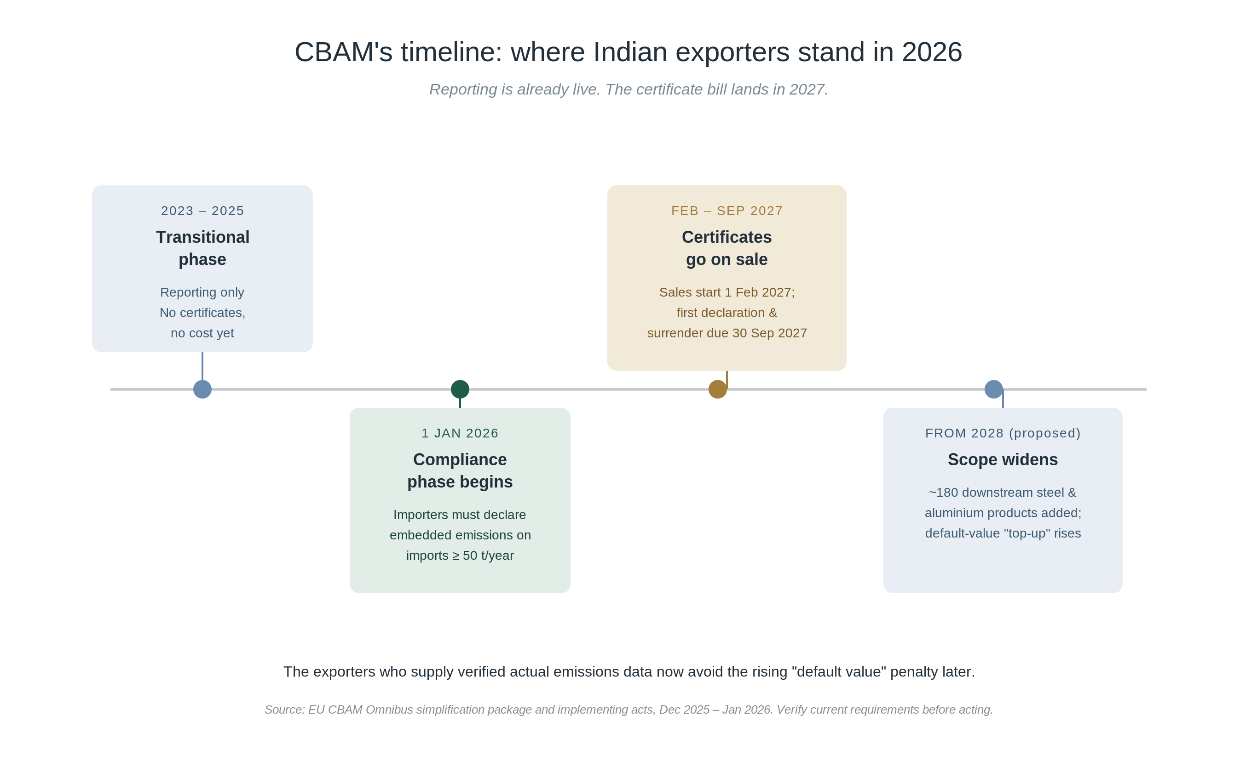
“If CBAM hits” conversation is over. It already hit on 1 January 2026. The certificate bill lands in 2027, but the reporting clock is already running.
Who Actually Pays – And Why That Doesn’t Let You Off the Hook
Here’s the detail that causes most confusion: the legal obligation to declare embedded emissions and eventually surrender CBAM certificates sits with the EU importer – your customer – not with you as the Indian exporter. It would be easy to conclude this is “their problem.” It isn’t, for one simple reason: your EU customer needs your actual emissions data to meet that obligation affordably, and if you can’t supply it, they fall back on EU-published default values.
Those default values are deliberately being made more expensive over time. Under the Omnibus package, most default values carry an upward “top-up” – roughly 10% in 2026, 20% in 2027, and 30% from 2028 onwards – specifically designed to discourage reliance on defaults and reward suppliers who provide verified actual data. (The fertiliser sector is treated differently, with a smaller annual adjustment reflecting agricultural sensitivities.) In practice, this means EU buyers have a rising financial incentive to prefer suppliers who can hand over verified numbers – and a rising incentive to move away from those who can’t.
The Real Risk Isn’t a Tax. It’s a Sourcing Decision.
This is the shift in framing I’d ask every exporting SME to make: CBAM is not, for you, primarily a tax you pay directly. It’s a data and credibility signal that increasingly shapes which suppliers EU buyers choose to keep. A buyer consolidating their supply chain around a handful of preferred vendors will lean toward the ones who make their own CBAM declaration cheaper and less risky – which means the ones who can produce verified Scope 1 and Scope 2 emissions data per unit of product, not the ones who force a default-value assumption onto the buyer’s books.
Since the reporting phase began, importers must declare embedded emissions on covered imports above a new 50-tonne annual mass threshold (hydrogen and electricity are excluded from this exemption). Certificate sales themselves don’t begin until 1 February 2027, and the first declaration and surrender deadline is 30 September 2027, covering emissions embedded in goods imported during 2026. That gap between “reporting starts” and “certificates are bought” is exactly the window in which supplier data quality gets tested and sourcing decisions get made.
The CBAM Readiness Ladder
I use a simple four-stage ladder with exporting clients to locate where they actually stand, since “are we CBAM-ready” is rarely a yes/no answer.
Stage 0 – Unaware
No emissions data of your own. Your EU customer is left to use default values on your behalf – increasingly expensive for them, and an increasingly visible risk on your side of the relationship.
Stage 1 – Measured
You can produce your own direct (Scope 1) and indirect (Scope 2) emissions per tonne or unit of product, mapped to the CBAM calculation methodology and your product’s relevant benchmark production route.
Stage 2 – Verified
Your emissions data has been checked by a third party against CBAM’s verification principles, so you can hand it to any EU customer on request rather than scrambling when one asks.
Stage 3 – Positioned
You use verified, lower carbon intensity as a genuine commercial advantage in EU bids and renewals – ahead of the proposed 2028 scope expansion to roughly 180 additional downstream steel and aluminium products, which will pull a wider set of exporters into this conversation.
Moving up the ladder isn’t a single project – it’s an operating capability. A baseline carbon footprint exercise (Scope 1 and 2, per product line) is typically the fastest way to get from Stage 0 to Stage 1; third-party verification and a clear internal owner for the quarterly reporting cadence take you to Stage 2; and consistently leading with your verified numbers in EU tenders is what gets you to Stage 3.
Building a baseline emissions footprint – the process typically takes a few months once you commit to it, in my experience. Data readiness has quietly become a tie-breaker in EU sourcing decisions, well before any certificate obligation technically touch.
Implementation Steps: What to Do This Quarter
- Confirm scope. Check which of your product lines fall under the current CBAM product codes for iron/steel, aluminium, cement, fertiliser, hydrogen or electricity – these lists are being extended, so re-check rather than relying on last year’s list.
- Build a baseline. Commission a Scope 1 and Scope 2 carbon footprint per tonne or unit for each in-scope product line this quarter.
- Ask your buyers directly. Contact your top two or three EU customers and ask exactly what data format and verification standard they will expect from you.
- Line up verification early. Third-party verification capacity will tighten as the September 2027 deadline approaches – don’t wait for the rush.
- Put it on a recurring calendar. Track certificate sales (from Feb 2027), benchmark updates, and the proposed 2028 downstream expansion as an ongoing compliance rhythm, not a one-off project.
Common Mistakes That Cost Exporters Their Standing
- Waiting for the EU customer to ask before starting – verified data systems take months to stand up, not weeks.
- Treating this as a one-time report rather than a recurring quarterly and annual obligation.
- Assuming “the importer pays the certificate” means “this doesn’t affect me” – it affects your competitiveness well before it affects your invoice.
- Relying on default values indefinitely, as the top-up makes them structurally more expensive for your buyer each year.
- Ignoring the proposed downstream expansion (~180 additional products from 2028) because it isn’t finalised yet – it’s close enough to plan around.
Where This Leaves Indian Exporters
CBAM is no longer a future risk to keep half an eye on. It’s a live regulation already reshaping how EU buyers choose and retain suppliers, and its effects reach Indian exporters well before any certificate cost technically applies to them. The exporters treating this as a data and credibility exercise now – not a compliance chore to defer – will be the ones EU buyers prefer once the full cost regime lands in 2027 and the scope widens from 2028.
Get Ahead of the Deadline
Download the CBAM Readiness Checklist – a 90-day implementation guide covering scope confirmation, baseline footprinting, buyer conversations, and verification planning, week by week.
Download the CBAM Readiness Checklist
Or if you’d like a straight read on where your product lines actually stand – book a 30-minute diagnostic call. I’ll tell you what I see and give you a roadmap. Whether you work with me or not.
Book Your Free Diagnostic Call
Jetinder Kumar Nath is the founder of SustainLead, where he integrates leadership coaching (LMI), ESG advisory, and digitainability strategy to help Indian SMEs build systematic competitive advantages. With 30 years of operational leadership experience, he helps businesses move from founder-dependent execution to scalable systems.
Sources referenced: European Commission, Taxation and Customs Union – CBAM legislation and guidance; International Carbon Action Partnership (ICAP) news coverage of the CBAM Omnibus package and compliance-phase entry, Dec 2025-Jan 2026.