
I’ve watched this happen at almost every SME I’ve worked with, in almost the exact same order.
A high performer – the best engineer, the sharpest salesperson, the most reliable operations hand – gets promoted to manager. Everyone celebrates. One year later, the same person is quietly drowning: still doing most of the technical work personally, frustrated that “the team can’t be trusted” with anything important, and privately wondering if they made a mistake taking the role.
Nobody made a mistake. Nobody trained them for the actual job either.
Why This Happens (And Why It’s Not Your Fault)
Most Indian SMEs promote on one criterion: competence in the current role. The best technician becomes the supervisor. The best salesperson becomes the sales manager. The best engineer becomes the engineering lead. This makes intuitive sense – and it is almost the wrong criterion entirely.
The skills that make someone an outstanding individual contributor – speed, technical depth, being the person with the answer – are frequently the opposite of what the next role demands: patience with someone else’s slower path to the same answer, comfort delegating outcomes rather than controlling steps, and a tolerance for watching mistakes happen in service of someone else’s learning.
There is usually no formal transition support. No structured onboarding into management, no coaching on the switch, no redefinition of what “doing a good job” now means. The new manager is left to figure out, alone and under pressure, that the scorecard has changed – while everyone around them, including their own boss, still evaluates them by the old one.
This is the same root pattern behind founder bottlenecks and the 30-40% utilisation problem I’ve written about before, except it starts one level down – at the very first promotion into people leadership. If it isn’t corrected here, it compounds every time that person promotes someone else the same way.
The Problem Deep Dive: Three Beliefs That Quietly Sabotage New Managers
In my work with first-time managers, the same three inherited beliefs show up almost every time:
- “If I explain it well enough once, they’ll get it.” This creates impatience with a normal learning curve, and frustration when someone doesn’t grasp in one pass what took the manager years of practice to master.
- “It’s faster if I just do it myself.” True the first time. False the fiftieth time, once it’s multiplied across a full team and every week going forward.
- “My value is what I personally produce.” This is the hardest one. A manager’s real output – capability built in other people – is invisible in the short term and doesn’t feel like “work” the way closing a ticket or finishing a report does.
I saw this clearly with an operations lead at a manufacturing client who, as a technician, personally closed 10-12 quality issues a day. Promoted to shift manager over eight technicians, he kept closing 8-10 issues a day himself out of habit – and the technicians’ own capability stayed exactly where it was. Headcount had grown; real throughput hadn’t, because nobody was playing the multiplier role the new title was supposed to create.
The Three Shifts: A Framework for the Transition
Over years of coaching first-time managers through this exact transition, I’ve found it easier to teach as three deliberate shifts – each with a change in scorecard and a change in daily behaviour.
Shift 1 – The Value Shift: From Personal Output to Team Output
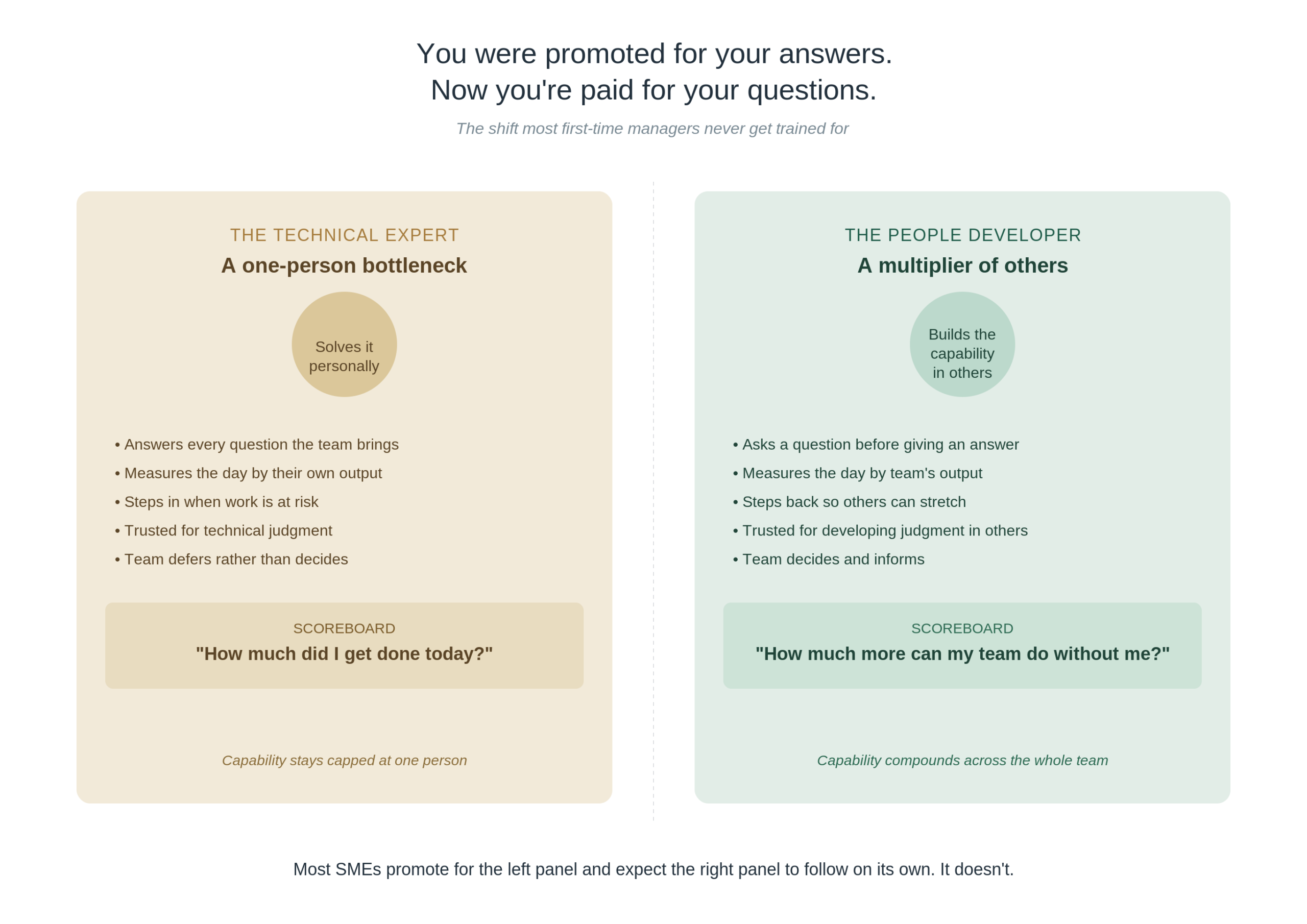
The old scorecard asks, “How much did I get done today?” The new scorecard asks, “How much more can my team do without me?” Every task a manager could hand over but doesn’t is a tax on the team’s ceiling, not a contribution to it.
Shift 2 – The Skill Shift: From Answering to Asking
Before giving an answer, ask a question first: “What have you tried?” or “What would you do if I weren’t here?” This is the same instinct behind coaching approaches like GROW – the manager’s job shifts from being the fastest source of the right answer to being the person who builds someone else’s ability to find it. It feels slower in the moment. It is faster within a quarter.
Shift 3 – The Identity Shift: From Best Doer to Best Developer
This is the shift people resist most, because it means giving up the identity that got them promoted. Success is redefined around bench strength: how many decisions the team now makes without escalating, how much the number of “can you just handle this” requests has dropped, and how the team performs when the manager is on leave.
Practical starting behaviours for each shift, to try this week:
- Value Shift: Track ‘team decisions made without me’ for one week as your real scorecard, alongside whatever your official metrics are.
- Skill Shift: In every 1:1 and floor conversation this week, ask one question before offering one answer.
- Identity Shift: Identify your top three ‘I always do this myself’ tasks, and hand over one this month – with a clear outcome standard, not a step-by-step script.
This connects directly to the Decision Authority thinking I’ve written about for founders: the same logic – clear boundaries, documented authority, tolerance for early mistakes – applies one level down, to a first-time manager and their own team.
A Real Example: The Floor Supervisor Who Got His Weekends Back
A mid-sized manufacturing client promoted their best machine operator to floor supervisor over twelve technicians. Within three months he was working every Saturday, personally re-checking work the team could have caught themselves, and escalations to him were constant.
We worked through the Three Shifts over a 90-day period: redefining his scorecard around team capability, building the ‘ask before answering’ habit into his daily floor walks, and formally handing over three recurring checks to senior technicians with clear standards attached.
By the end of the 90 days, escalations to him had dropped by roughly 40% – an approximate figure from his own informal tracking, worth verifying with your own data rather than treating as a guaranteed benchmark – and he took his first full weekend off in months. The technicians hadn’t suddenly become more capable. They’d simply been allowed to use the capability they already had.
Implementation Steps: Your First 30 Days
- Log it. For one week, note every time you personally solve something a direct report could have learned to solve instead.
- Pick one. From your log, choose your top three recurring ‘I always do this myself’ tasks, and hand one over this month with a defined outcome standard.
- Ask before you answer. Build the single habit of one coaching question before every answer, in every 1:1 and floor conversation.
- Change your own scorecard. Write down what you will measure your week by from now on – team capability, not personal output – and review it every Friday.
Common Mistakes That Derail This Transition
- Handing over the task but not the authority – delegating the work while still approving every step, which teaches nothing.
- Confusing patience with permissiveness – coaching someone through a task still requires clear standards and deadlines.
- Trying to do both jobs at once, indefinitely – some short-term slowdown during the transition is normal; treat it as an investment with a defined end date, not a permanent state.
- Never telling the team the rules changed – direct reports will keep coming to you as the go-to expert unless you explicitly reset the expectation.
The Real Shift
The promotion changed the job description. Almost nobody changes the scorecard sitting in the new manager’s head. That gap – between a title that says ‘developer of people’ and a mindset that still says ‘best individual performer’ – is what keeps capable people stuck as glorified individual contributors with a manager’s title and a manager’s stress.
The fix isn’t more technical training. It’s a deliberate, coached shift in where you spend your time and what you count as a win.
Ready to Make the Shift?
If you’d rather talk through your specific situation – yours, or a manager you’ve just promoted – book a 30-minute diagnostic call. I’ll tell you what I see and give you a roadmap. Whether you work with me or not.
Book Your Free Diagnostic Call
Your newest managers are more capable than their first few months suggest. They just need the right shift, at the right time.
Keywords: #first-time manager challenges; #technical expert to leader; #leadership transition; #coaching vs doing; #new manager training; #leadership pipeline
Jetinder Kumar Nath is the founder of SustainLead, where he integrates leadership coaching (LMI), ESG advisory, and digitainability strategy to help Indian SMEs build systematic competitive advantages. With 30 years of operational leadership experience, he helps businesses move from founder-dependent execution to scalable systems.