
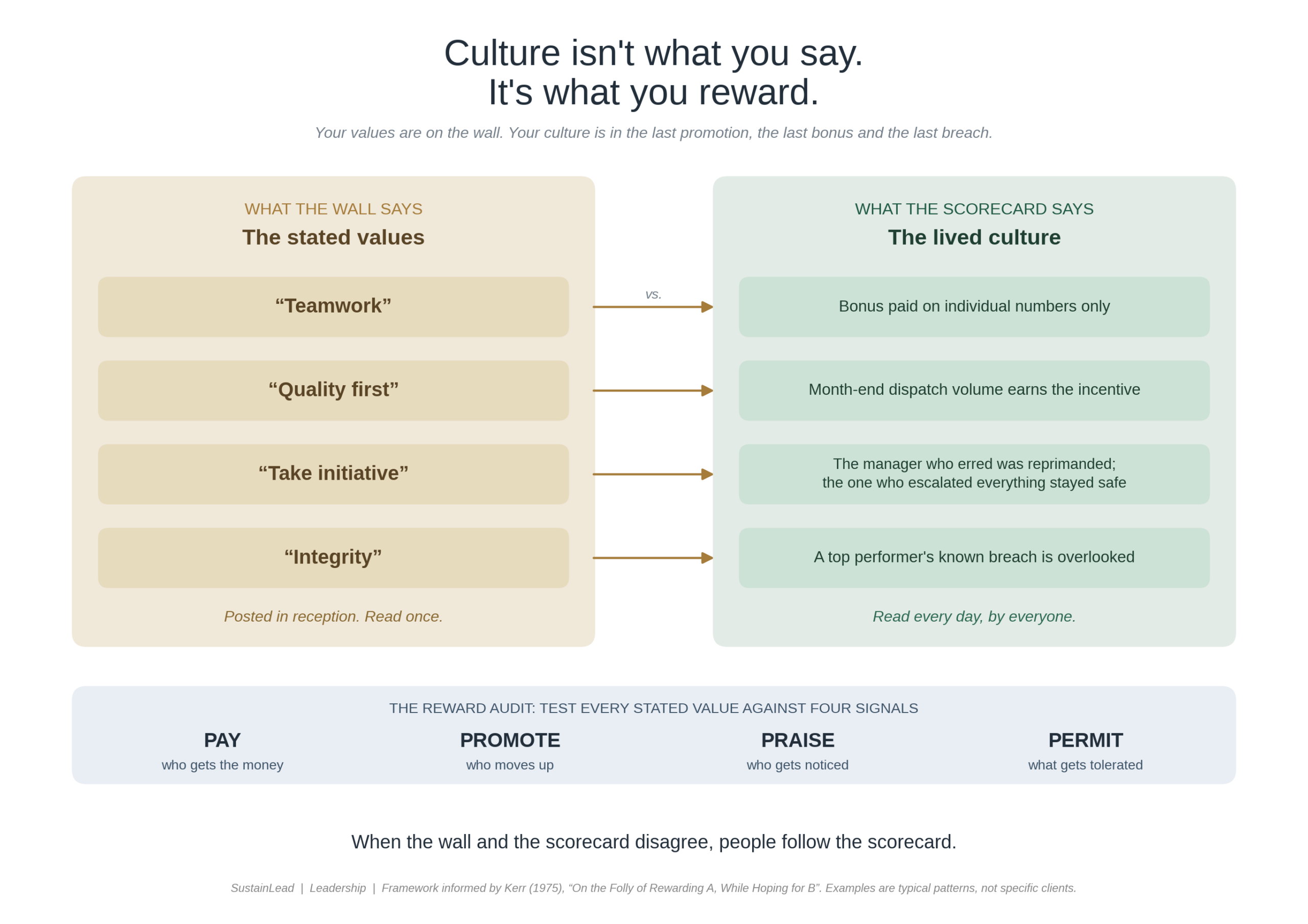
Walk into almost any organization and you will find the values: painted in reception, printed in the handbook, repeated at the annual day. Teamwork. Quality. Integrity. Ownership.
Then I ask three questions. Who was promoted last? Who received the largest bonus? And which known behaviour did leadership last overlook because the person delivers results?
The answers describe the real culture. They rarely match the wall.
This matters commercially, not just culturally. In an organization, culture works as an operating system. It decides how fast decisions travel, whether bad news reaches the owner while it is still cheap to fix, and whether managers act sensibly when nobody is watching. A culture that says one thing and rewards another quietly taxes all three.
Why the Wall Never Wins
Edgar Schein’s well-known model of organisational culture separates visible artefacts, espoused values and basic underlying assumptions. The deepest layer, the assumptions, is what actually drives behaviour, and it forms through repeated experience of what the organisation rewards and what it punishes. A poster is an espoused value. A promotion is evidence.
Steven Kerr made the practical version of this point in his 1975 paper “On the Folly of Rewarding A, While Hoping for B” (Academy of Management Journal). Organisations, he argued, routinely reward one behaviour while hoping for another. Fifty years later, it remains one of the most common culture problems I see in Indian SMEs.
It is not a communication problem. It is an incentive-and-attention problem, and no amount of re-announcing the values will fix it.
The Four Signals Employees Actually Read
Employees do not study your values statement. They read behaviour, through four signals:
- Pay: who gets the money. If bonuses follow individual numbers, “teamwork” is decoration.
- Promote: who moves up. If the promoted are always the fastest firefighter, people learn that fires are a career path.
- Praise: who gets noticed. In a founder-led business, whatever the owner thanks, questions or ignores in a review meeting becomes a priority within days.
- Permit: what gets tolerated. This is the most powerful signal. A known breach by a high performer that goes unaddressed tells everyone the value has an exception, and the exception is performance.
In an owner-led SME these signals are amplified, because the promoter is often the entire reward system.
Three Contradictions I See Repeatedly
- “We value teamwork”: but incentives are paid only on individual targets. Colleagues compete for credit and hoard information.
- “Quality comes first”: but the month-end incentive is linked to dispatch volume. Borderline lots get pushed out, and everyone understands why.
- “Take initiative”: but the manager who took a decision and got it wrong was reprimanded in front of peers, while the one who escalated everything stayed safe. Decisions drift upward to the owner, the same pattern behind the 30-40% utilisation problem I have written about earlier.
None of this is deliberate. It accumulates. Each reward decision looked reasonable at the time; together they teach the opposite of the stated value.
An Illustrative Scenario
Consider a manufacturing company whose first stated value is “Quality First.” Its incentive is tied to monthly dispatch value. In the last three days of each month, inspection thresholds are quietly stretched to clear stock. Nobody wrote an instruction to do this. Nobody had to. The incentive did it.
The owner’s instinct is another quality workshop, which changes nothing. What does change things is a pair of decisions: adding first-pass quality yield as a gate on the incentive, and visibly holding back one questionable lot in a tight month. One decision fixes Pay; the other fixes Permit.
The Reward Audit: A 30-Day Framework
Test each stated value against the four signals (Pay, Promote, Praise, Permit) and mark each one Aligned, Silent or Contradicting.
- Choose the three values you cite most often.
- Gather twelve months of evidence: the last five promotions, bonus recipients, public recognitions, and any breaches and what happened next.
- Score each value on the four signals.
- Fix the cheapest, most visible contradiction first, for example by adding a behavioural criterion to appraisals or addressing one tolerated breach.
- Tell the team what changed and why. An unexplained change reads as arbitrary; an explained one reads as a statement.
What Rewarding the Right Behaviour Looks Like
Once the contradictions are visible, the corrections are usually modest and specific:
- Pay: add a team or cross-functional component to incentives, so that helping a colleague is never a financial loss.
- Promote: include evidence of developing others as a promotion criterion, not only individual results. This is the same logic I described in the transition from technical expert to people developer.
- Praise: recognise the specific behaviour, not just the outcome. “You flagged the defect before dispatch” teaches more than “well done”.
- Permit: apply consequences consistently, starting with the people whose results make it most tempting to look away.
A value marked Silent in the audit is not a failure, but it is an opening. If nothing rewards a value, that is the easiest place to begin.
Common Mistakes
- Rewriting the values instead of changing the rewards.
- Running a culture workshop with no change in incentives, which spends goodwill and delivers nothing.
- Applying consequences to junior staff but not to top performers.
- Changing rewards silently, so nobody connects the change to the value.
- Expecting one quarter to be enough. In my experience, shifting underlying assumptions takes several quarters of consistent signals.
The Real Shift
Culture is not a campaign. It is the accumulation of reward decisions, made visibly and repeatedly. Leaders who want a different culture rarely need new words; they need different decisions.
One reason the gap persists is that leaders seldom see how their own reactions are read. A structured 360-degree conversation often surfaces it faster than any engagement survey.
Your people already know what your culture is. They learnt it from watching what you reward.
Jetinder Kumar Nath is the founder of SustainLead, where he integrates leadership coaching (LMI), ESG advisory, and digitainability strategy to help Indian SMEs build systematic competitive advantages. With 30 years of operational leadership experience, he helps businesses move from founder-dependent execution to scalable systems.
Sources referenced: Schein, E. H., Organizational Culture and Leadership (Jossey-Bass; multiple editions); Kerr, S. (1975), “On the Folly of Rewarding A, While Hoping for B”, Academy of Management Journal, 18(4), 769-783. Scenarios are illustrative composites.