
Your managers aren’t underperforming. They’re operating exactly as you’ve trained them — to wait for your approval.
A business owner recently told me his managers weren’t stepping up. The team waited for decisions instead of making them. Growth had stalled — not because of the market, but because he had become the bottleneck.
When I asked what his managers could decide independently, there was a long pause. “They should check with me first on important things.”
I asked what counted as “important.” Another pause. “Most things, really.”
That’s when I knew we’d found the problem — and it wasn’t the managers.
The Silent Addiction: How Approval Culture Takes Hold
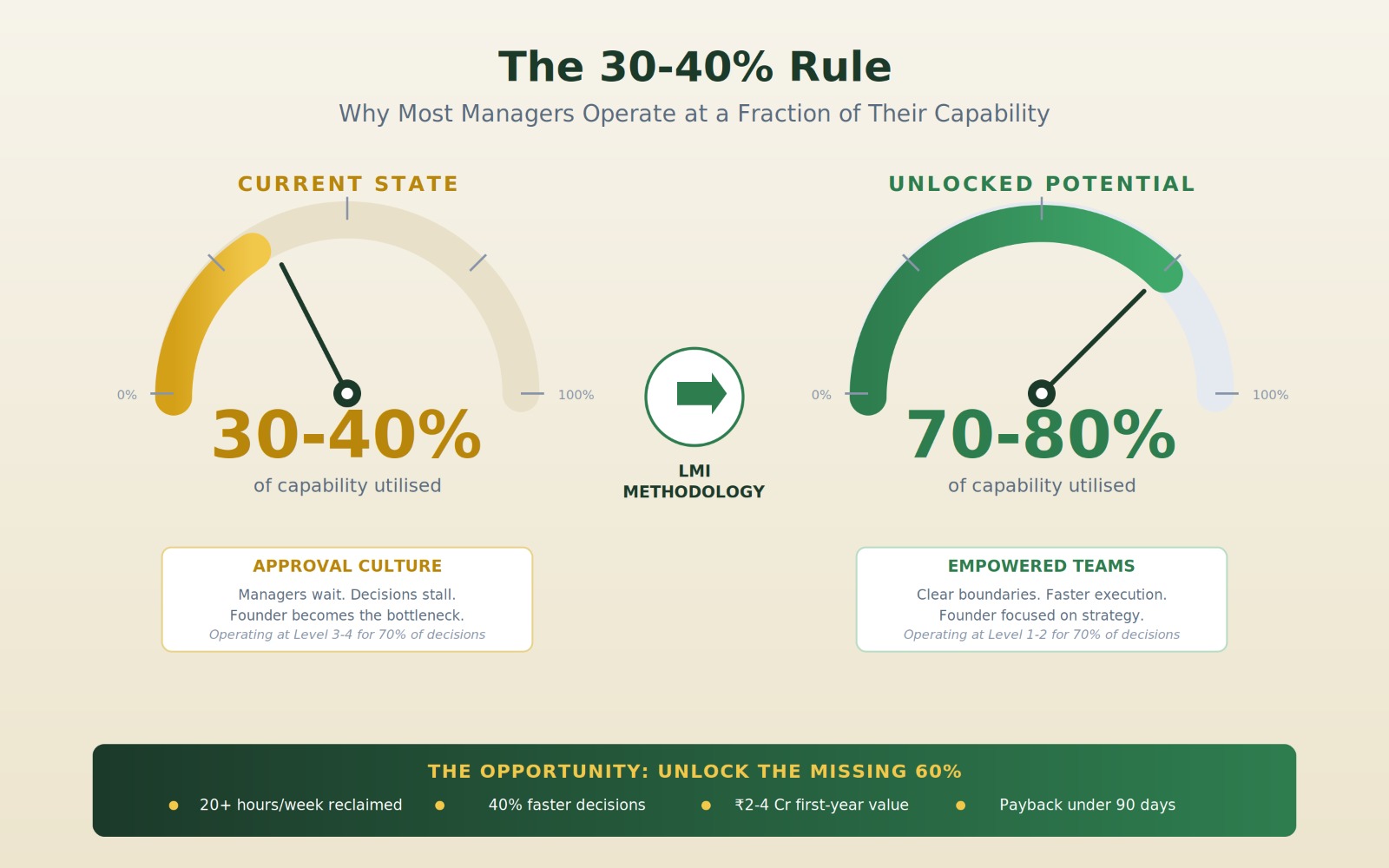
Here’s what most owners don’t realise: you’ve trained your team to operate at 30-40% of their actual capability.
Not intentionally — but through a thousand small interactions. Every time you stepped in to “just handle this quickly,” second-guessed a call, or said “Next time, check with me first,” you taught your managers that their judgment isn’t trusted.
Capable people, when they learn their judgment isn’t valued, stop using it. They shift into safe mode: do the task, wait for instructions, avoid risk, check before acting. You end up with experienced professionals operating like juniors — not because they can’t do more, but because you’ve inadvertently taught them not to.
Why You Didn’t See It Coming
Early on, you genuinely were the best person to make most decisions — you knew the customers, the product, the relationships. But as the business scaled from 10 people to 100, from ₹10 crore to
₹100 crore, decision volume outpaced your capacity. The habit remained. Managers still check.
You still approve. Except now it’s 50 decisions a week instead of 10.
The insidious part? It feels productive. You’re solving problems, adding value, being needed. But you’re really building a dependency that prevents the organisation from scaling. You’ve become the constraint.
The Hidden Price Tag of Approval Culture
Imagine three managers, each bringing 15 decisions a week, they could handle alone. That’s 45 decisions flowing to you. At roughly 30 minutes each, that’s 22.5 hours a week — nearly three full working days — on calls your managers could make themselves.
Your time is only part of it. Decisions get delayed 2-3 days. Customer issues escalate. Competitive responses slow. Innovation dies because “let me check with the boss” kills initiative. And managers never develop decision-making skills — they never practise.
A Real Turnaround: From 70-Hour Weeks to a Real Vacation
I worked with a mid-sized manufacturer last year. The founder was clocking 70 hours a week, personally approving purchase orders, discounts above 5%, hiring, production changes, and marketing spend over ₹25,000. His operations manager — a professional with 15 years of experience — checked in 8-10 times a day.
The owner went through LMI’s Effective Personal Productivity program. The operations manager could now approve purchases up to ₹2 lakhs, handle discounts up to 10% within margin guidelines, manage production within capacity, and resolve quality issues via established protocols.
Results after 90 days: approval requests dropped from 50+ to fewer than 10 a week. Decision speed rose 40%. Customer issues are resolved in hours instead of days. Six months in, the founder took his first two-week vacation in eight years — and the business ran smoothly.
The operations manager wasn’t suddenly more capable. He always was. We simply removed the constraint keeping him at 30-40%.
Your LMI Four-Step Roadmap to the Shift
- Map your current decision flow and Time Picture. For one week, log every decision that comes to you, make a time picture of how you spend your time: what it was, why it needed approval,and whether someone else could have handled Most owners find that 60-70% could’ve been handled by others.
- Buildyour High Payoff Activities and Decision Authority Define your High Payoff activities. Then assign each decision type to one of the four levels with specific boundaries — financial limits, scope, risk tolerance, and documentation. Precise boundaries work; vague ones don’t.
- Communicateand train, one-on-one. Walk each manager through the matrix, explain the why behind each boundary, and express genuine confidence in their Crucially, tell them you expect mistakes — learning requires practice.
- Startsmall and Begin with lower-stakes Level 1 decisions. Review at 30 days, expand scope as confidence grows. By 90 days, expect a 60-70% drop in approval requests and noticeably faster execution.
The key insight: Most managers should operate at Level 1-2 for 70% of decisions. In an approval culture, they’re stuck at Level 3-4 for 70%. That’s your 30-40% utilisation problem in one sentence.
Five Pitfalls That Will Quietly Kill This
- Overridingyour own Step in anyway and you’ve added bureaucracy without empowerment.
- Punishingthe first One “See, this is why you should check with me” teaches managers never to decide again.
- Vague “Use your judgment” isn’t a boundary. A specific rupee limit with documentation is.
- No Level 1-2 decisions should still be visible — not for approval, but for learning.
- Expecting perfection. A 95% success rate is excellent. Obsessing over the 5% destroys the initiative.
The ROI: What Unlocking the Other 60% Is Worth
Free up 10 hours a week, and you reclaim 500 hours a year — at ₹10,000/hour opportunity value, that’s ₹50 lakh in value created. Lift three managers from 40% to 75% capability, and you’ve added roughly ₹39 lakh in productivity without a single new hire.
Add faster customer response, real-time production decisions, and quicker vendor negotiations, and the typical first-year value in a mid-sized business lands between ₹2-4 crore. Payback is usually under 90 – 120 days.
Start With One Manager — This Week
You don’t need to overhaul everything tomorrow. Pick one manager you trust. Implement the Decision Authority Matrix with them. Give it 60 days — you’ll see the difference, and so will they. Then expand to the next. Within six months, you’ll have an organisation running at 70-80% of its capability instead of 30-40%. And you’ll have your life back.