ESG isn’t corporate social responsibility with better branding. For Indian SMEs, it has quietly become the license to compete. Here’s what that actually means for your business.
Last month, a promoter called me with a problem he hadn’t seen coming.
His company — a garment exporter with around ₹180 crore in revenue, solid quality systems, and thirty years of steady customer relationships — had just been told by their largest European buyer to submit a Scope 1 and 2 emissions inventory, a water use disclosure, and evidence of a supplier code of conduct. The deadline was ninety days. The alternative was being dropped from the approved vendor list at the next annual review.
He said, “We’ve been supplying them for eleven years. Never had a complaint. Now suddenly I need to become an environmentalist?”
He wasn’t wrong to be frustrated. But he was wrong about what was happening.
This wasn’t a values conversation. His buyer hadn’t discovered a new love for the planet. What had changed was the buyer’s own regulatory and investor environment — and that pressure was now flowing downstream, straight to his factory floor. He had two choices: treat ESG as a compliance irritant and lose the contract, or treat it as a commercial capability and keep it.
That’s the conversation I want to have with you today – The balance sheet version of ESG.
The Shift Nobody Announced
Five years ago, if you ran an Indian SME, you could reasonably ignore ESG. It was a topic for listed entities, multinationals, and CSR officers. You focused on quality, cost, and delivery. That was enough.
That era ended while most of us were looking elsewhere. I’ve watched it happen in real time across my client base. The same questions that used to show up in rare annual audits are now on the first vendor registration form. The same documentation that used to be “nice to have” is now a precondition for onboarding. And critically, the companies asking these questions aren’t asking out of idealism — they’re asking because their own customers, regulators, and investors are asking them.
ESG has become the quiet admission fee for a growing number of supply chains. And unlike most admission fees, this one doesn’t come with a clear signboard at the entrance. You only find out you needed it when you’re told you’re being replaced.
Three Forces That Changed the Game
Three forces are converging on Indian SMEs right now, and understanding them matters more than understanding any specific framework.
The first is regulation. BRSR reporting is currently mandated for the top 1,000 listed companies, but the expectation is spreading. Those listed companies now expect equivalent data from their unlisted suppliers. Add CBAM, which directly taxes the embedded carbon in Indian exports to the EU starting 2026, and the ripple effects are no longer theoretical — they’re in purchase orders.
The second is capital. Banks and NBFCs are beginning to tier lending based on ESG risk. Private equity and strategic acquirers are building ESG screens into diligence. If you’re planning a capital raise, a succession sale, or even a working capital enhancement in the next three years, your ESG posture is now part of your valuation conversation — whether or not anyone mentions the word.
The third is customers. B2B buyers, especially those exporting to Europe, North America, and Japan, have started asking for data that most Indian SMEs don’t currently collect. Not occasionally. Routinely. The “preferred supplier” lists are being rewritten around these capabilities, and once you’re off that list, getting back on is considerably harder than staying on it was.
The Quiet Cost of Staying “Traditional”
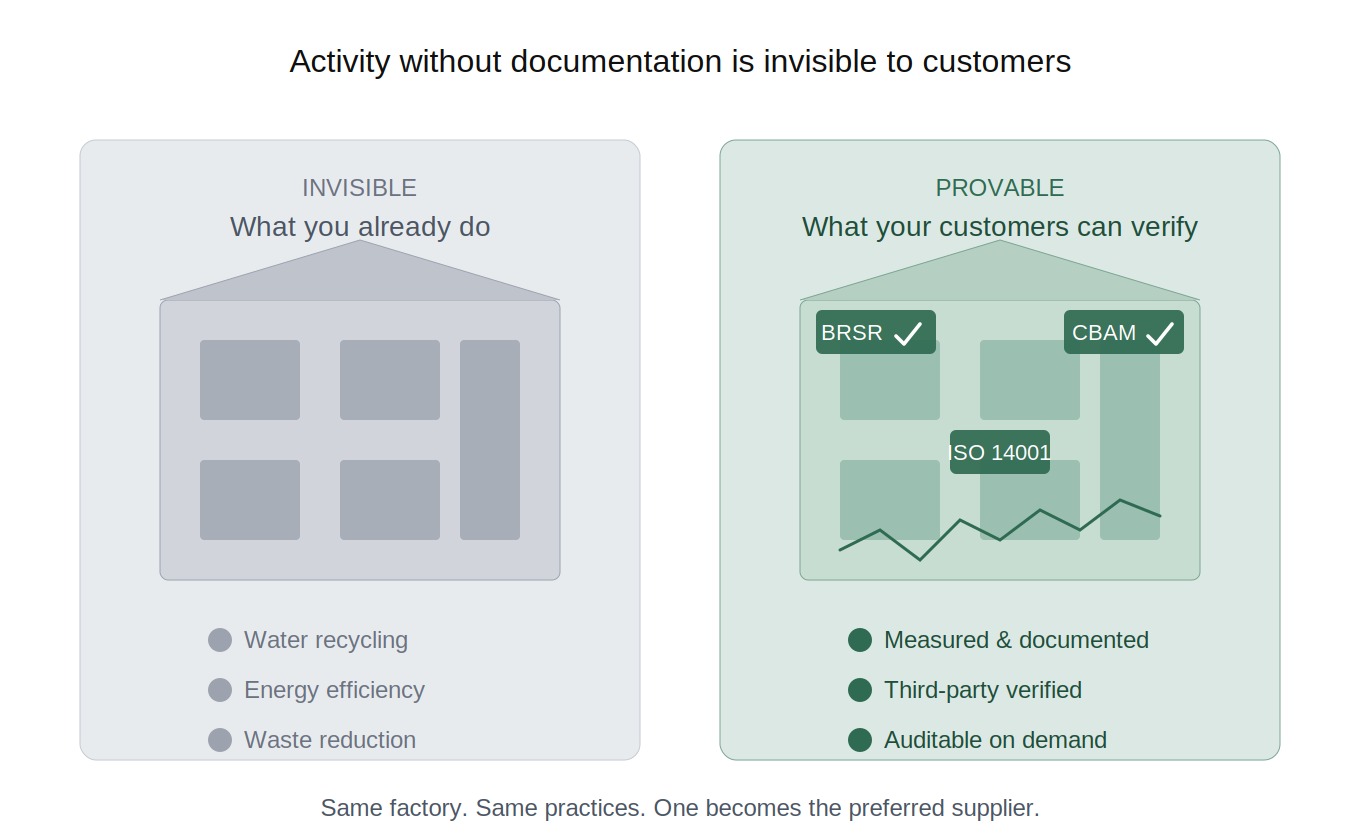
Here’s what I’ve observed, repeatedly: the companies that are losing ground to ESG pressure are rarely losing because they pollute more or treat workers worse than their competitors. They’re losing because their competitors have learned to document, verify, and communicate what they’re already doing.
Let me give you a concrete example.
I worked with a speciality chemicals company that had, over several years, built a genuinely good water recycling system. They were reusing a large share of their process water, had invested in a sewage treatment plant, and were edging toward zero liquid discharge. By any real-world measure, they were ahead of most of their peers.
But when a large customer asked for documented evidence, they had nothing to show. No baseline data, no measurement protocol, no third-party validation, no dashboard. Just the quiet confidence of people who knew what they’d built but had never had to prove it.
We spent three months translating their existing practices into a documented, auditable system. No new capital was deployed. No new technology was bought. We simply made the invisible visible. Not only did they satisfy the customer, but they are confident of meeting any other customer requirements with the same documentation requirements.
The lesson is uncomfortable but important: activity without documentation is invisible to customers. And increasingly, invisibility is being priced as absence.
What Realist ESG Actually Looks Like
Let me be blunt about what I think ESG isn’t, before I say what it is.
It isn’t a sustainability report designed to win a design award. It isn’t a CSR brochure. It isn’t a consultant-led exercise that produces a 60-page PDF nobody reads. And it absolutely isn’t about abandoning commercial logic for moral posturing.
Realist ESG, as I practice it with SME clients, rests on four practical ideas.
- Measure what your customers, regulators, and lenders will actually ask for — not everything theoretically possible.
- Document what you already do well, because you almost certainly have more of a story than you think.
- Prioritise changes that reduce cost or risk at the same time they reduce impact, because that’s where ESG and operations genuinely converge.
- And integrate ESG into existing business rhythms — the monthly review, the capex process, the vendor onboarding — rather than running it as a parallel, isolated initiative.
This last point is the one I care about most. ESG that sits in a silo dies in a silo. ESG that’s woven into how your leaders already lead, and how your operations already operate, is what actually survives the first difficult quarter.
Where to Start (Without Hiring a Consultant First)
If you’re reading this and realising you’re closer to my friend than you’d like to be, here’s what I’d suggest before you do anything else.
Start by asking your top three customers one simple question: “What ESG data or documentation are you likely to ask of us over the next twenty-four months?” Most of them will tell you, in surprising detail. That answer is your real scope — not what a framework says, not what a consultant sells, but what your actual commercial relationships require.
Then take an honest inventory of what you already do. You will almost certainly find more than you expect. The gap between “doing” and “provable” is usually the shortest, cheapest, and highest-ROI path to being contract-ready.
And finally, give this work an owner inside the business. Not a committee. One person, with authority, is accountable for closing the gap against a defined timeline. ESG dies in matrices and lives in ownership.
ESG isn’t about saving the planet. It’s about staying on the preferred supplier list, qualifying for better capital, and being in the room when growth capital flows your way.
It’s less ambitious than the brochures suggest. It’s also considerably more urgent.
If you’d like a clearer sense of where your business stands commercially on ESG, call to have a direct conversation. A 30-minute diagnostic call will give you an honest read on your gaps and your priorities — whether we end up working together or not.
Book Your Free Diagnostic Call
Jetinder Kumar Nath is the founder of SustainLead, where he integrates leadership coaching (LMI), ESG advisory, and digitainability strategy to help Indian SMEs build systematic competitive advantages. With 30 years of operational leadership experience, he helps businesses move from founder-dependent execution to scalable systems.