
Most Indian SME founders are stuck running their business from the urgent. Lasting growth begins the moment they learn to run it from the important.
A founder I work with described his Monday morning to me recently. I think it’ll feel familiar to anyone running an SME in India today.
He had walked into office at 8:45 with a clear list. By 9:30, none of it was happening. A key customer had escalated a dispatch delay. A senior engineer had called in sick on the morning of an important plant visit. The bank had asked for additional documentation by end of day. A dealer had threatened to switch suppliers over a pricing argument. And his quality head had walked in to ask whether they should approve a new vendor for a critical raw material.
By 1 PM, he had handled all of it. Capably. Decisively. With the kind of operational reflex that thirty years of running a business builds into your bones.
And then he looked up, and realised he had not done a single thing he had actually planned to do that morning. The strategic review. The two interviews. The capex proposal. None of it. He had run the business beautifully, and he had moved nothing forward.
“Jetinder,” he said when we spoke that week, “every Monday is some version of this. I keep telling myself next week will be different. It never is.”
This is the firefighting trap. And in my experience, it is the single biggest reason capable, intelligent SME founders find themselves stuck at the same revenue, the same complexity, the same level of personal exhaustion year after year — even when their businesses look healthy from the outside.
The Trap That Hides in Plain Sight
Firefighting is seductive. When you handle a crisis, you get an immediate sense of progress. The dispatch goes out. The customer is calmed. You feel useful, decisive, indispensable. Over years, that small reward shapes how you spend your time without you ever quite choosing to.
Strategic work offers none of that immediacy. Thinking through your three-year customer mix, redesigning your sales process, planning a leadership succession — none of this gives you a closed loop at the end of an afternoon. The reward, if it comes at all, comes in quarters or years.
So the urgent keeps winning the calendar. The important keeps getting postponed to “next week, when things settle.” Things never settle. That is the hard truth most founders only confront after they’ve spent a decade waiting.
What Firefighting Actually Costs
The cost shows up in places founders don’t immediately connect back to the way they spend their day.
It shows up as a leadership team that has stopped bringing you decisions because they’ve learned you’ll either redo their work or override it under pressure. As a sales pipeline that grows when you travel and stalls when you’re back, because every account waits for your attention. As capex decisions that sit unresolved for weeks, not because they’re complex, but because there’s no quiet hour in your week to sit with them. And eventually, as a business operating below its potential — not by 5%, but often by 30% or 40% — because the only person capable of strategic thinking in the building is the only person who never has time to do any.
None of this is visible from inside the day. Each individual fire feels legitimate. Each crisis genuinely needs handling. The trap isn’t that any single fire is illegitimate. The trap is that the cumulative pattern is unsustainable — and yet feels, in the moment, like the only responsible way to run the business.
The Two-Part Shift That Changes Everything
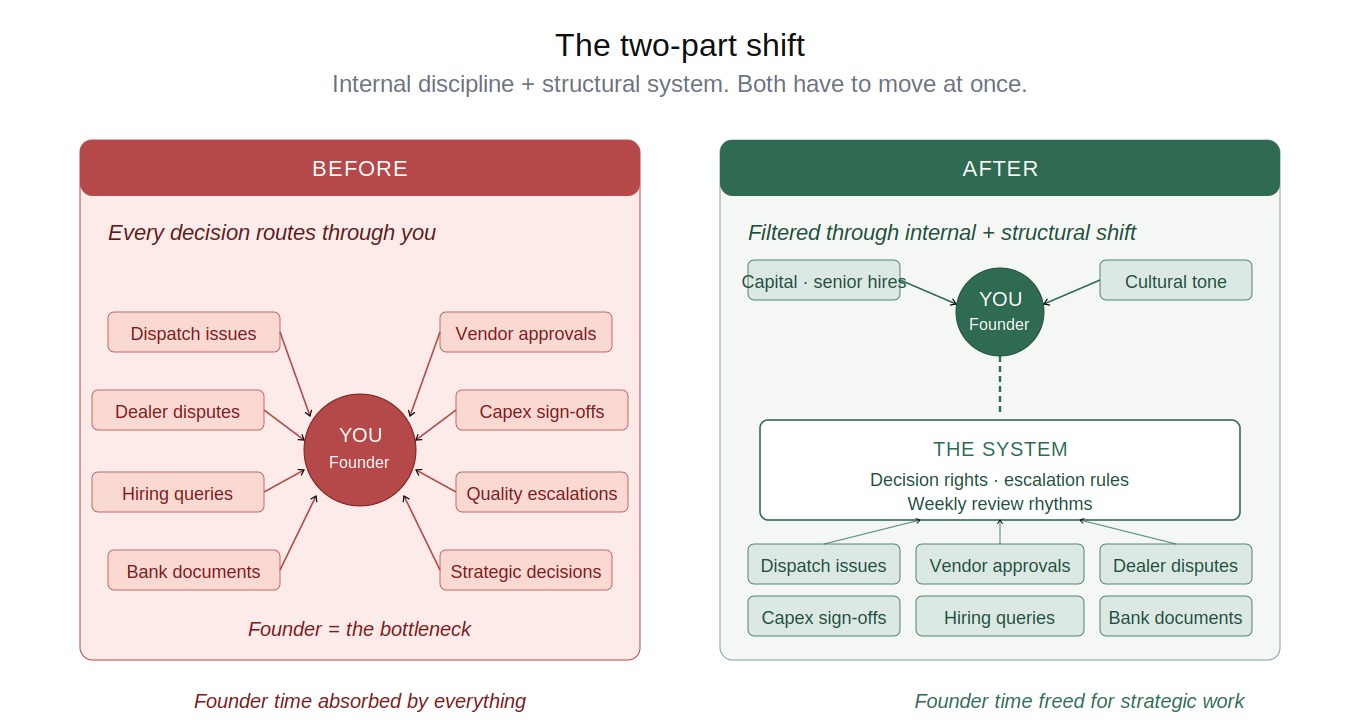
In my work with founders trying to escape this trap, I’ve found two shifts have to happen together. Either alone produces frustration; both together produce real, sustainable change.
The first shift is internal. It is the discipline of distinguishing what only you can do from what is currently being routed to you because the system has been built around your availability. Most founders, when they make this list honestly, are surprised at how short the “only I can do this” column actually is. The strategic decisions, the major capital commitments, the senior hires, the cultural tone, the external relationships at the very top — these are genuinely yours. Most of the rest is yours by default, not by necessity.
The second shift is structural. It is about building decision rights, escalation rules, and review rhythms so that the things that don’t need you have a clear path that doesn’t run through your inbox. Defining authority limits, creating standard operating procedures for predictable decisions, instituting weekly operational reviews that resolve issues before they become escalations. Unglamorous work — but the highest-leverage work an SME founder can do, because every hour invested in the structure returns ten hours of reclaimed founder attention over the following months.
Without the internal shift, the structure won’t hold — you’ll keep undermining it by accepting escalations that should have been resolved below you. Without the structural shift, the internal discipline collapses under the first real crisis. Both have to move at once.
A Practical Place to Begin This Quarter
If you recognise yourself in any of this, here is the simplest first move I know — one I’ve watched dozens of founders use to break the cycle.
For two weeks, at the end of each day, take five minutes to write down every interruption, escalation, or decision that came to you. Just a list. Don’t try to fix anything yet.
At the end of the fortnight, sort the list into three columns. First: things that genuinely required your judgement and could not have been handled at any other level. Second: things that came to you because the person below you didn’t have the authority, the framework, or the confidence to decide on their own. Third: things that came to you out of habit — yours or theirs — even though they didn’t need to.
In almost every case I’ve seen, the first column is between 15 and 25 percent of the total. The other 75 to 85 percent is recoverable founder time, hiding in plain sight.
That recovered time is where focused growth begins. Not in a planning offsite. Not in a consultant’s recommendation. In the quiet discipline of refusing to absorb decisions that could be made without you, and building the structures so that they are.
The founders who make this transition don’t become less involved in their businesses. They become differently involved — the person who decides where the business goes next, with both the time and the clarity of mind to do it well. That’s the version of leadership your business actually needs from you. The fires, mostly, take care of themselves once the system is built to handle them.
Where to Go from Here
If you’d like a structured way to map your own firefighting pattern and identify where your founder time is genuinely being lost, download The Founder’s Time Audit — a simple two-week template that turns the exercise above into a clear, defensible map of where your attention is going and where it should be going instead.
Or, if you’d prefer to talk it through, a 30-minute diagnostic call will give you an honest outside view on where your firefighting is hiding and what a realistic ninety-day path out of it could look like — whether we end up working together or not.