
You have twenty managers. If you disappeared for one or two months, how many of their departments would continue to run without you? That number is your real leadership pipeline.
A promoter I’ve worked with asked me a question last week that I’ve been thinking about ever since.
“Jetinder,” he said, “I know I need to build my second line. Everyone keeps telling me that. But honestly, I look at my twenty managers, and I can’t figure out which ones actually possess leadership qualities and which ones I’m just hoping they do. How do I tell?”
It’s the right question. And it’s the question most SME founders never quite let themselves ask, because the honest answer is usually uncomfortable.
So let me offer the test to use. It’s simple, and it’s ruthless. I call it the two-month test.
The 2-Month Test
Imagine — hypothetically — that you had to step away from your business entirely for two months. No phone calls. No WhatsApp approvals. No Sunday night check-ins. Your managers would run their functions on their own.
Now walk through your org chart, name by name, and ask yourself one question for each: could this person hold their department together for three months, make the judgment calls, handle the surprises, and hand me back something I’d be proud of when I returned?
Most founders I ask this of get to a number very quickly. And that number is almost always smaller than the number of managers they actually employ.
That gap — between the managers you have and the leaders who’d hold up under the three-month test — is your real leadership pipeline. Or more often, the absence of one.
This isn’t a criticism of your people. In almost every case, it’s a reflection of the development system they’ve been operating inside. You promoted your best doers into management roles because they’d earned it. You assumed, reasonably, that capability in the old job would translate into capability in the new one. And you gave them a title, a team, and a target — but not the one thing that would have made them leaders rather than promoted executors.
Managers vs. Leaders — The Distinction Most SMEs Miss
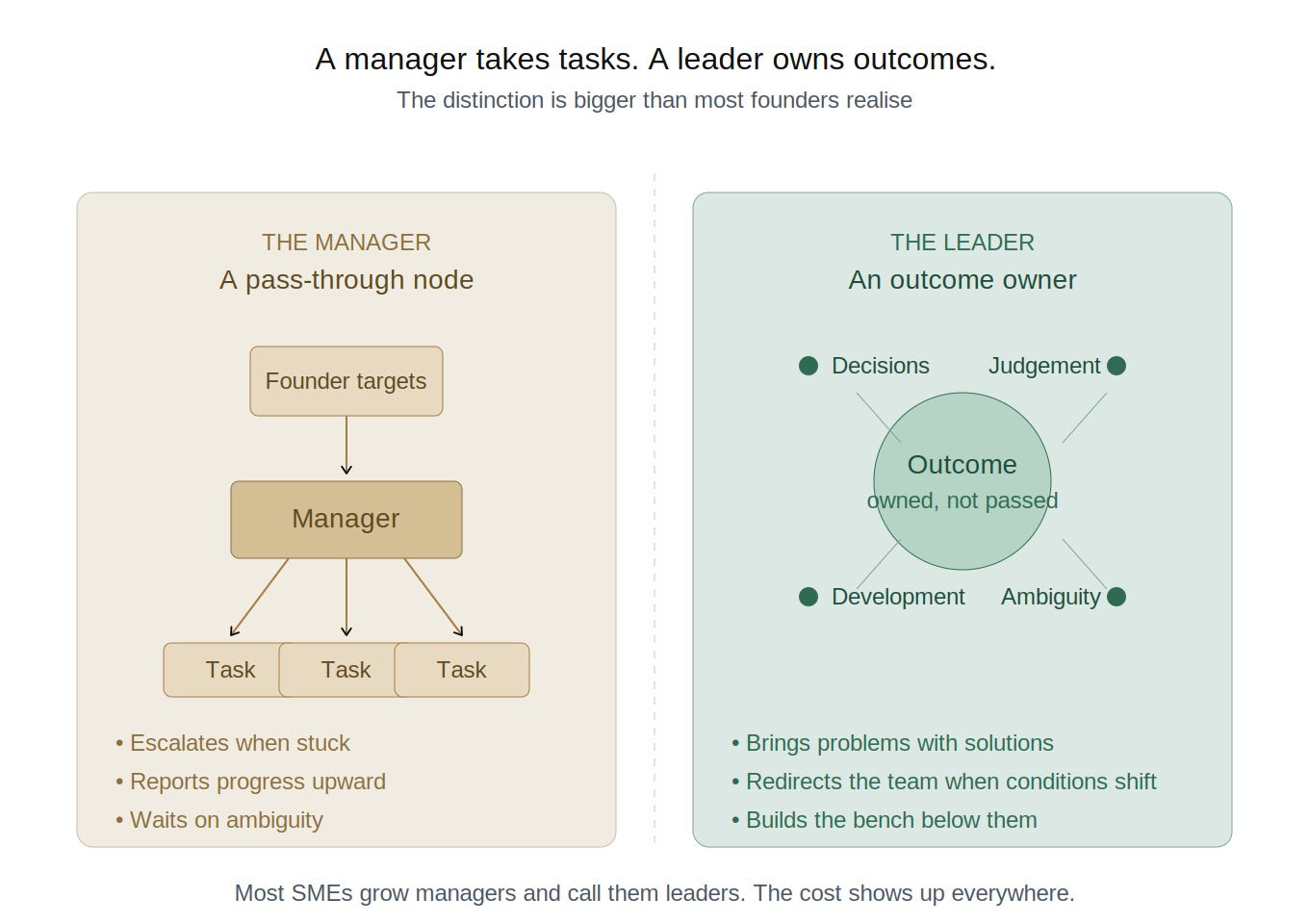
There is a difference between managing tasks and owning outcomes, and it’s bigger than most founders realise.
A manager, in the way Indian SMEs typically grow them, is someone who takes your targets, breaks them into activities, allocates those activities to their team, and reports progress back to you. They’re essentially a high-quality execution layer between you and the work. When something goes wrong, they escalate. When something goes right, they report. When something ambiguous happens, they wait.
A leader does something different. A leader treats the outcome as theirs — not as a task they’ve been handed. They make judgment calls within a defined zone of authority. They redirect their team when conditions change, without waiting for instructions. They bring you problems with their recommended solution, not problems and then their request for yours. And most importantly, they develop the people under them, because they’ve understood that their capacity is capped by the capability of the team they’ve built.
Most SMEs have managers doing tasks, not leaders owning outcomes. And the cost of this distinction shows up in places founders don’t always connect back to its source.
It shows up as customer relationships that live in the founder’s phone rather than the company’s system. As a sales funnel that wobbles whenever you’re travelling. As capex decisions that wait three weeks for your signature because nobody else is authorised to sign. As quality escalations that only get resolved when you personally intervene. As a valuation discount — sometimes a significant one — when a strategic buyer or investor realises that the business, stripped of you, would be materially less than what it looks like on paper.
Why the Pipeline Is Empty (and It’s Not What You Think)
Here’s the part that surprises most founders when I walk them through it.
The reason your leadership pipeline is thin is rarely that you’ve hired the wrong people, or because Indian talent is weaker than talent elsewhere, or because your industry “doesn’t attract leadership types.” I’ve worked across manufacturing, chemicals, engineering, and services, and the pattern holds everywhere.
The pipeline is thin because leadership has been treated as something that either emerges on its own or doesn’t. As a personality trait rather than a capability. As something you spot, not something you build.
So the development systems that would turn a good manager into a genuine leader don’t exist. There is no structured programme for first-time managers moving from individual contribution to leading a team. There is no distinct developmental track for mid-level managers who need to shift from running functions to leading across functions. There is no deliberate exposure path that puts future leaders into the kinds of decisions, stakeholder interactions, and ambiguity that stretch them before the business actually depends on them.
Instead, people learn leadership by being thrown into it, watching you, and hoping some of it rubs off. Some of it does. A lot of it doesn’t. And the ones who naturally absorb it become your small, overworked core. The rest stay managers, because that’s what the system produced them to be.
What Building a Real Pipeline Looks Like
Building leadership bench strength is not mysterious, but it is deliberate.
It starts with defining what leadership means at each level in your business — first-time manager, functional head, business leader — in terms of the decisions they should be making, the scope they should be owning, and the behaviours that distinguish capability from title. Without this, “leadership development” stays abstract, and abstract interventions produce abstract results.
It continues with structured development at each of those levels. The LMI programs I work with are deliberately tiered for this reason — what a first-time manager needs is genuinely different from what a functional head needs, and running one generic programme for everyone produces ceremonial certificates and not much else. Real development pairs concept with practice, practice with coaching, and coaching with measurement over time.
And it requires the uncomfortable part: deliberately pushing authority down, earlier than you’re comfortable with, in controlled ways. Leaders are built by exposure to decisions, not by theory about decisions. If you never let them decide, you never find out what they can do. And you certainly never build a pipeline you can rely on.
Where to Start This Quarter
You need a transformation programme to make visible progress on this in ninety days.
Take your top ten managers. For each one, name the two or three decisions you currently make on their behalf that they should, with some coaching and framing, be making themselves. Assign those decisions to them, explicitly, with a check-in rhythm you’re comfortable with. Watch what happens.
A subset will surprise you — these are your real pipeline, and they deserve investment. A subset will struggle visibly — these are your development priorities. And a subset will hand the decisions back to you in every way they can find — these are the honest conversations you’ve been postponing.
That’s how pipelines actually get built. Not through leadership talks. Through the deliberate transfer of leadership — decision by decision, person by person, quarter by quarter.
If you’d like to understand better and talk it through, a 30-minute diagnostic call will give you an honest outside view of your pipeline — whether we end up working together or not.
Jetinder Kumar Nath is the founder of SustainLead, where he integrates leadership coaching (LMI), ESG advisory, and digitainability strategy to help Indian SMEs build systematic competitive advantages. With 30 years of operational leadership experience, he helps businesses move from founder-dependent execution to scalable systems.